

- Insurance first, everything else second. Georgia does not require a state roofing license. Workers’ Compensation and General Liability Insurance are the only non-negotiable credentials. Verify both before requesting an estimate.
- Voluntary credentials separate professionals from the pack. A GARCA voluntary license and manufacturer certifications from GAF or Owens Corning confirm training, continuing education, and access to extended warranty options.
- Local experience matters more than company size. Georgia’s climate ranges from coastal salt air and hurricane exposure to inland heat and UV stress. A contractor who has worked in your specific region will specify the right materials and ventilation for your conditions.
- Verify reputation across three sources. Google reviews show customer experience, BBB accreditation confirms complaint resolution processes, and industry awards or manufacturer preferred status validate professional standing.
- Demand line-item estimates. A complete quote breaks out materials, labor, permits, tear-off, disposal, and structural repair separately. Lump-sum quotes make fair comparison impossible and leave room for hidden charges.
- Warranties have two parts. Material warranties come from the manufacturer (25 to 50 years). Workmanship warranties come from the contractor. Both should be in writing before work begins.
Verify licensing credentials, insurance coverage, and manufacturer certifications before comparing anything else. Those three items eliminate most unqualified contractors in a single step. Georgia’s roofing market sits between $2 billion and $2.5 billion, which means homeowners have hundreds of companies to choose from and no state-mandated roofing license to filter the list. The qualities below give you a concrete checklist for narrowing that field to the contractors worth hiring.
| Quality | Why It Matters | What to Verify |
| Credentials and Insurance | Protects you from liability and confirms professional standards | Workers’ Comp, General Liability, voluntary GARCA license, manufacturer certifications |
| Experience and Track Record | Proves the company can handle your specific roof type and project scale | Years in business, completed project portfolio, customer reviews |
| Local Knowledge | Ensures materials and methods match Georgia’s climate and building codes | Regional references, familiarity with coastal humidity and storm exposure |
| Reputation and Accreditation | Indicates consistent quality across many projects | Google reviews, BBB rating, industry awards |
| Transparent Pricing | Prevents surprise costs and hidden fees | Detailed written estimates with material, labor, and permit breakdowns |
| Quality Materials | Determines how long the roof lasts and what warranty options are available | Brand partnerships (GAF, Owens Corning), material certifications |
| Project Management and Communication | Directly affects your experience during the project and protects your home from exposure | Realistic timelines, regular updates, safety protocols, emergency availability |
| Warranty and Support | Provides long-term protection after the job is complete | Written warranty terms, post-installation support policy, response time |
What Credentials Should a Georgia Roofing Contractor Have?
At minimum, a Georgia roofing contractor should carry Workers’ Compensation Insurance and General Liability Insurance. Georgia does not require a state-issued roofing license. The State Licensing Board classifies roofing contractors as Exempt Specialty Contractors, which means anyone can legally offer roofing services without passing a state exam or holding a state credential. That gap makes insurance verification the single most important step a homeowner can take before signing a contract.
Workers’ Compensation covers employees injured on the job. General Liability protects the homeowner from property damage claims and financial responsibility if something goes wrong during the project. A contractor without both of these policies transfers that risk directly to you.
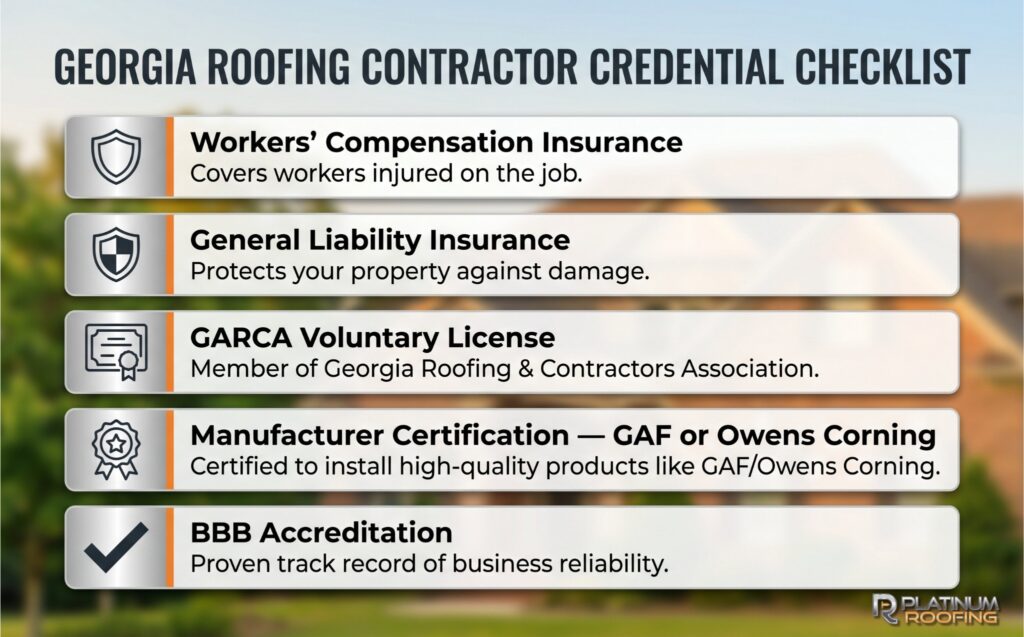
Beyond insurance, look for voluntary credentials that signal a higher standard. The Georgia Roofing Contractors Association (GARCA) offers a voluntary licensing program for both residential (steep-slope) and commercial (low-slope) contractors. A GARCA-licensed contractor has submitted proof of insurance, passed an examination, and committed to continuing education. Manufacturer certifications from companies like GAF or Owens Corning indicate advanced installation training and often unlock extended warranty options that are not available through uncertified installers.
| Credential | Georgia Requirement | What It Protects |
| State Roofing License | Not required (Exempt Specialty Contractor) | N/A |
| Workers’ Compensation Insurance | Required for contractors with employees | Covers workers injured on the job |
| General Liability Insurance | Industry standard (strongly recommended) | Protects homeowner from property damage and liability claims |
| GARCA Voluntary License | Optional | Confirms exam completion, insurance, and continuing education |
| Manufacturer Certifications | Optional | Unlocks extended warranty options and confirms installation training |
Why Does Experience Matter More in Georgia’s Roofing Market?
Georgia’s combination of extreme heat, coastal humidity, and a storm season that runs from June through November demands contractors who have handled all three. A company with a strong portfolio of completed projects across different roof types and Georgia regions is more likely to recommend materials and installation methods that hold up under local conditions than a contractor who recently entered the market.
With 35 to 40 percent of roofing contractors nationwide reporting difficulty finding qualified workers, workforce stability is another reason experience matters. Established companies with long-tenured crews are less likely to rely on subcontracted labor that may lack familiarity with Georgia-specific building practices. Before hiring, ask to see a portfolio of completed projects, read customer reviews on Google and the Better Business Bureau, and confirm how long the company has operated in your region.
How Does Local Knowledge Affect Roofing Quality in Georgia?
A contractor familiar with your region will specify materials and ventilation strategies that a national chain or out-of-state storm chaser would not consider. Georgia’s climate varies significantly from the coast to the Piedmont to the southern plains, and each zone creates different stress on roofing systems.
Coastal areas around Brunswick and Savannah deal with salt air corrosion, high humidity, and direct hurricane exposure. Metal roofing panels in these zones need corrosion-resistant coatings, and underlayment choices must account for moisture that standard inland installations can ignore. In the Atlanta metro area, intense summer heat and UV exposure are the primary concerns, making reflective and impact-rated materials more relevant. Southern Georgia around Valdosta faces a longer warm season with frequent afternoon thunderstorms that test drainage and flashing integrity.
A locally experienced contractor also understands municipal permit requirements, which vary by county across Georgia, and can handle the permitting process without delays. They are more likely to be available for emergency inspections and repairs after storms because their crews are already in the area.
What Separates a Good Reputation from a Great One?
A great reputation is backed by verifiable third-party credentials, not just positive reviews. Online reviews on Google and Facebook are a starting point, but they only tell you what individual customers experienced. Third-party accreditations add a layer of accountability that reviews alone cannot provide.
BBB accreditation means the company has committed to resolving customer complaints through a formal process and has met the Bureau’s standards for trust. Industry awards, such as recognition from Roofing Contractor magazine’s Top 100 list, indicate peer-level validation that goes beyond customer satisfaction. Manufacturer-designated preferred contractor status (like GAF Master Elite or Owens Corning Platinum Preferred) confirms that the company meets ongoing performance and training benchmarks set by the material manufacturers themselves.
Check all three: reviews for customer experience, BBB for complaint resolution, and industry credentials for professional standing. A company that scores well across all three is significantly more reliable than one that relies on reviews alone.
What Should a Roofing Estimate Include?
A complete roofing estimate should break down materials, labor, permits, debris removal, and any additional work into separate line items. Vague lump-sum quotes make it impossible to compare contractors fairly and leave room for unexpected charges after the project starts.
Specifically, the estimate should list the roofing material brand and product line, the square footage being covered, the cost per square for materials and labor separately, permit fees for your county, old roof tear-off and disposal costs, and any structural repair that may be needed once the existing roof is removed. If the estimate does not include these items as separate line items, ask for a revised version before signing.
Asphalt shingles account for 75 to 80 percent of residential roofing projects in Georgia. Metal roofing, stone-coated steel, and flat-roof systems make up the remainder. The material you choose affects both the upfront cost and the warranty terms, so the estimate should clearly state what is being installed and what warranty applies.
How Should a Roofing Company Manage Your Project from Start to Finish?
The best contractors provide a written timeline before work begins and communicate proactively at every stage. Delays on a roofing project are not just inconvenient. An open roof exposes your home to water damage, pest entry, and structural risk for every day the project runs past schedule. In Georgia’s storm season, that exposure window can turn a routine replacement into an insurance claim.
Before hiring, ask how the company handles communication during the project. You should expect a dedicated point of contact, regular progress updates, and clear protocols for weather delays. Safety practices matter too. A professional crew should arrive with fall protection, proper equipment, and a plan for protecting your landscaping and property during tear-off and installation.
Companies that offer emergency services alongside standard project work demonstrate the operational capacity to respond when something goes wrong, both during your project and after. This is especially valuable in Georgia, where storm damage can create urgent repair needs months or years after the original installation.
What Warranty and Support Should You Expect After the Job Is Done?
A strong warranty covers both the materials and the workmanship, and the company should clearly explain what each covers before you sign. Material warranties come from the manufacturer and typically range from 25 to 50 years depending on the product. Workmanship warranties come from the contractor and cover installation errors. These two are separate, and both need to be in writing.
After-project support is equally important. A company that is responsive to post-installation concerns, whether a minor leak at a flashing point or a question about attic ventilation, demonstrates that their commitment extends beyond the final invoice. Ask about the company’s process for handling warranty claims: who to contact, what the expected response time is, and whether inspections are included.
Financing options can also factor into the warranty decision. Some manufacturers offer extended warranty terms when the installation is financed through an approved program, which can add 10 to 25 years of additional coverage at no extra material cost.
Ready to Compare Georgia Roofing Companies?
Choosing the right roofing contractor is one of the largest investments you can make on your property. A company that carries proper insurance, holds voluntary GARCA credentials, and provides a detailed written estimate with clear warranty terms is worth the time it takes to verify. Platinum Roofing serves communities across Georgia, including Valdosta, Brunswick, Columbus, and surrounding areas, with over 5,000 roofs replaced and 500 five-star reviews.